Ready to Run Adds WBGT to Garmin Watch Faces
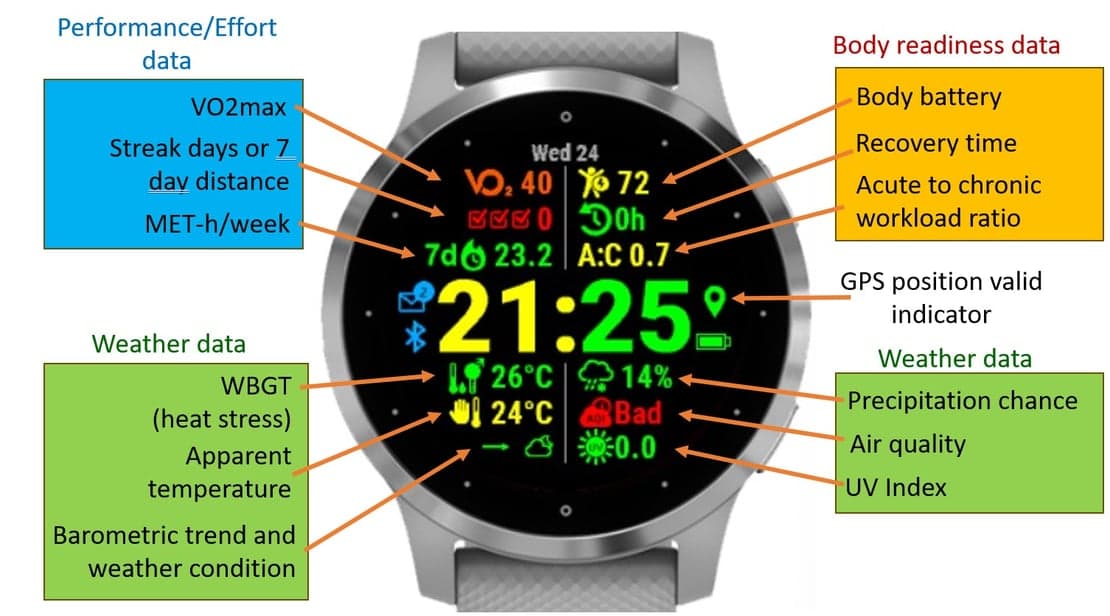
Ready to Run is a Connect IQ watch face from Trudelta that puts Garmin body-readiness metrics, training goals and weather on one screen. Its standout is WBGT, a heat-stress measure absent from Garmin’s stock faces, according to the5kRunner. For runners facing humid, sunny or still conditions, that is far more useful than glancing at a basic temperature reading and guessing.
One glance, three decisions
The layout splits the job cleanly. Body Battery, recovery time and acute-to-chronic workload ratio sit at the top right. VO2 max, active MET-hours and a running streak sit at the top left, with options to swap in 7-day distance or intensity minutes. Weather fills the lower portion with apparent temperature, rain chance, barometric-pressure trend, air quality, UV index and WBGT.
The Pro version turns those fields red, amber or green. Goals are green when achieved, amber from 70 to 99 per cent, and red below that, while the hour digits reflect the average body-readiness colour and minutes reflect weather. It is a smart use of a watch face: less dashboard clutter, more pre-run decision support. We have also seen how much useful functionality independent Connect IQ developers can squeeze onto Garmin hardware in our look at [five Garmin battery-alert apps](/en/articles/garmin-battery-alert-connect-iq-apps-five-indie-tools-reviewed-2026-07-30).
Why WBGT is the useful metric
WBGT combines air temperature, humidity, wind speed and direct sunlight to estimate heat stress on the body. That matters because a humid, windless route in direct sun can be tougher than a warmer but dry and breezy day. Temperature alone does not capture that. The5kRunner describes WBGT as the measure sports bodies use when deciding whether events need extra drink breaks or cancellation.
The face does not pretend that one number fits every athlete. The source stresses that heat acclimation changes how an athlete responds at the same WBGT. Its developer, Ken, uses personal rules of carrying hydration or shortening a run above about 26°C WBGT, and taking a rest day or using a treadmill above about 31°C. Those are useful examples, not universal prescriptions. The face can prompt the right question before training: is today’s planned session sensible in these conditions?
Training context without another widget
There is useful depth beneath the colours. The workload ratio compares the last seven days of running with the previous four weeks, making sudden jumps easier to spot than Garmin’s unitless Acute Load figure, in Trudelta’s view. Active MET-hours are broader than logged workouts because they count all activity above rest, including movement that never became a recorded session. Runners living at moderate or high altitude can also show elevation-compensated VO2 max, something the source says Garmin’s altitude-acclimation feature does not provide.
What is missing? The source gives no price for Pro, despite colour coding being locked behind it, and it does not explain how often weather values refresh or how the face handles a poor forecast. More importantly, traffic lights can oversimplify recovery, injury risk and heat tolerance. A green display is not clearance to force a hard workout, while red should not automatically mean panic.
Verdict: Ready to Run looks like a strong Garmin add-on for runners who want heat context and training cues before leaving the door, rather than digging through widgets and the Connect app. Not perfect. But unusually practical.
Mentioned watches
Head-to-head comparisons