Oura Ring 4 Review: The Sleep Tracker That Sets the Standard
What It Is
The Oura Ring 4 is a screenless smart ring aimed at health-conscious adults who prioritize sleep quality, recovery, and long-term wellness tracking over real-time workout metrics. It sits in the premium tier at around $349 to $499 depending on finish, plus a $5.99 monthly subscription for full data access. Its closest competitors are the Whoop 4.0 strap and the Ultrahuman Ring AIR, and it is increasingly positioning itself not just as a consumer gadget but as a bridge between personal health data and the medical world.
Key Specs
- Form factor: Titanium ring, available in multiple finishes
- Weight: 4-6g depending on size
- Battery life: Up to 7 days (roughly 168h between charges)
- Display: None, screenless
- Sensors: Infrared and red LED PPG for HRV and SpO2, skin temperature sensor, accelerometer
- Altimeter: Not present
- GPS: None onboard, relies on connected phone GPS for workout routes
- Water resistance: 100m water resistant
Performance in the Real World
Sleep tracking is where Oura genuinely earns its price tag. Independent research cited across multiple sources places Oura ahead of Garmin and roughly on par with Whoop for sleep stage identification accuracy. Garmin wrist-based devices show only 40-50% agreement with polysomnography for sleep stages, a damning figure. Oura, worn on the finger where the arterial signal is cleaner, consistently outperforms that benchmark. If you are buying a wearable primarily to understand your sleep, this matters enormously.
HRV accuracy during sleep is another area where Oura stands out. In a head-to-head comparison, Oura and Whoop both beat Garmin for consistent physiological metrics during sleep. The finger-based sensor placement gives Oura a real hardware advantage here, not a marketing one. Resting HRV readings from Oura are widely trusted enough that platforms like athletedata use Oura data directly to feed AI coaching recommendations alongside Garmin and TrainingPeaks data.
Where Oura falls short is active workout tracking. Without onboard GPS, any run or ride you want mapped depends entirely on your phone being present and paired. Heart rate accuracy during high-intensity efforts is also not a strength of any PPG ring at this point, and Oura is no exception. If you need reliable HR zones during intervals or a live pace on your wrist, this is not the right tool. The ring is built for the other 22 hours of your day, not the workout hour.
SpO2 and skin temperature sensors are present and functional. The temperature sensor in particular has proven useful for menstrual cycle tracking and early illness detection, two use cases where Oura has built a genuine reputation. The company launched a Blood Pressure Profile Study in October 2025, signaling ambitions to add hypertension risk detection, though this is not a validated feature yet.
The app ecosystem is strong. Oura connects with Apple Health, Google Fit, and a growing list of third-party platforms. The acquisition of Galen AI, a Stanford-founded startup linking consumer health apps to medical records across more than 800 healthcare systems, is a significant strategic move. It signals that Oura wants your ring data to eventually talk to your doctor's systems. That is a longer-term value proposition, but it is a credible one. TIME Magazine recognized Oura alongside Ultrahuman and AliveCor as health tech innovators, while Garmin and Whoop were notably absent from that list.
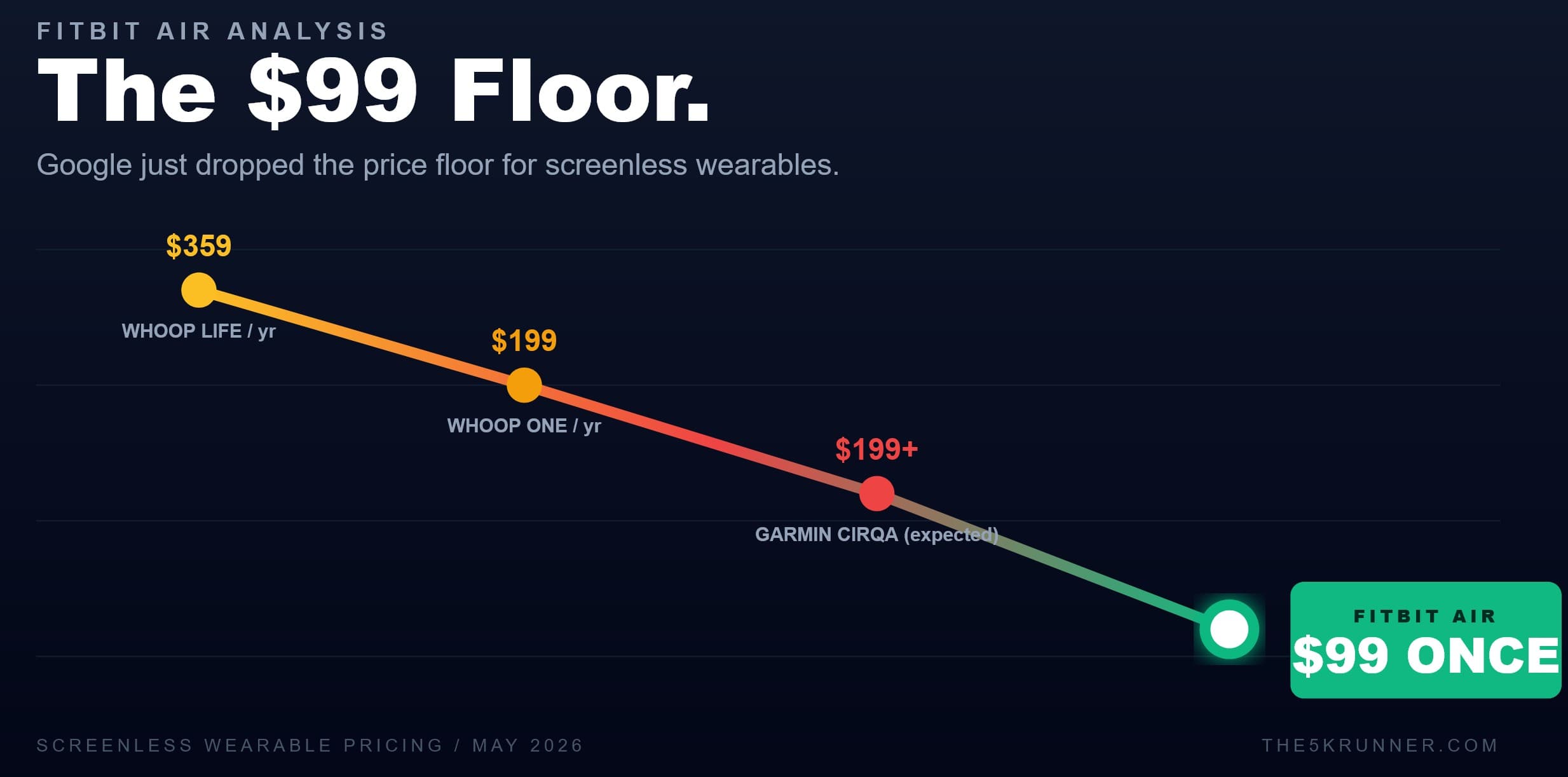
The subscription model is a real friction point. You pay $350 or more for the hardware, then $5.99 per month to access the full feature set. Newer competitors like the Fitbit Air are targeting exactly this weakness, offering no subscription at $99.99. For many users, the Oura subscription cost over two years adds $143 to the total, making it a $490 plus investment for a ring with no screen and no GPS.
Who It's For / Who Should Skip It
Buy the Oura Ring 4 if sleep quality, HRV tracking, and recovery data are your primary concerns. It is the right choice for people who find wrist wearables uncomfortable, who want a device they can wear 24 hours without thinking about it, and who are willing to pay for genuinely accurate physiological data. It works well as a complement to a sport watch rather than a replacement for one.
Skip it if you are primarily a runner or cyclist who needs GPS and real-time HR zones. Skip it if the subscription model bothers you on principle, because cheaper alternatives are now real options. Skip it if you want workout-focused metrics, app-controlled music, notifications, or any kind of display. The Whoop 4.0 is the natural comparison and offers a similar recovery-first philosophy in a strap format with more workout integration. Ultrahuman Ring AIR offers a subscription-free alternative at a similar hardware price point.
Verdict
The Oura Ring 4 is the best sleep and recovery tracker you can buy, and the research backs that up. The lack of GPS and the ongoing subscription cost are real drawbacks that prevent it from being a complete solution for active users. Wear it alongside a sport watch and it is a powerful combination. Wear it alone and you will feel its limitations every time you lace up.
Where to buy
Oura Ring 4
7.5/10 — TrackerBrief score