Garmin and Coros Owners Most Likely to Switch Brands in 2026
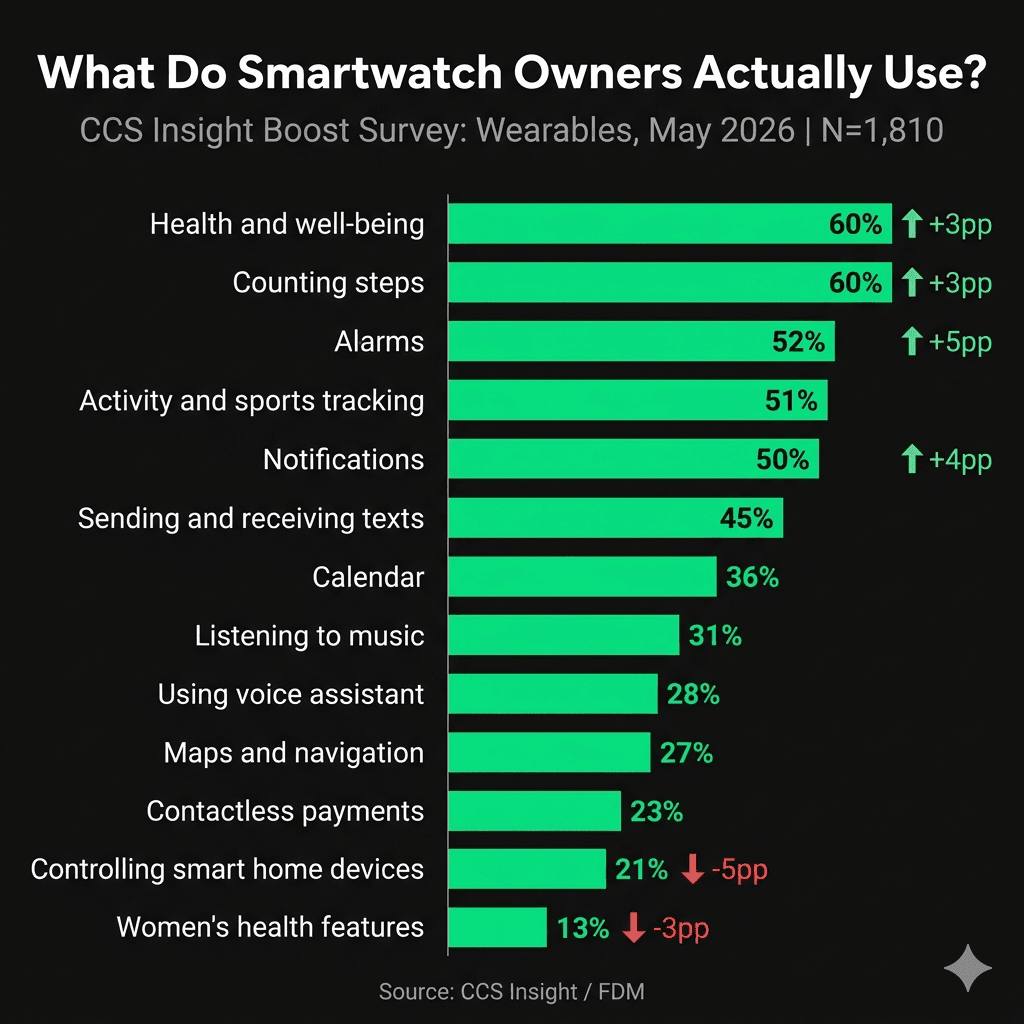
A new survey has found that 56% of smartwatch owners are open to switching brands, and Garmin and Coros users are leading that charge. Apple sits at the opposite end, with just 38% of its users considering a move elsewhere. The numbers are striking, but they make sense once you look at what's actually driving loyalty and defection in the endurance watch market right now.
Why Apple Keeps Its Users
Apple's retention advantage has almost nothing to do with GPS accuracy or wrist-based PPG heart rate performance. It's ecosystem lock-in. Your messages, your payments, your health records, your AirPods pairing, your family sharing setup. Apple Watch users are not primarily athletes, and for the casual fitness crowd the switching cost is genuinely high. The Apple Watch Ultra 2 does offer a solid optical heart rate sensor and a barometric altimeter for elevation via air pressure, but serious triathletes know its GPS multi-band is still trailing Garmin's Elevate + SatIQ combo in dense forest or canyon running. Battery life is also a hard ceiling at around 60 hours in low-power GPS mode versus the Garmin Fenix 8's 90-plus hours at full GPS.
The Garmin and Coros Loyalty Problem
Garmin's issue is a paradox. The brand makes arguably the most feature-complete endurance watches on the market in 2026, from the Forerunner 965 to the Fenix 8 Solar, with chest strap ECG compatibility via ANT+ and Bluetooth, barometric altimeters, multi-frequency GPS, and training load tools that Whoop and Polar can't fully match on wrist alone. But features alone don't generate loyalty when the software feels dated and the UI hasn't had a serious overhaul in years. Garmin users know the firmware is constantly being patched, as covered in our [Q2 2026 firmware roundup](/en/articles/garmin-q2-2026-firmware-six-watch-features-two-edge-updates-explained-2026-06-06) and the [June bug fix list](/en/articles/garmin-bug-roundup-june-2026-seven-fixes-endurance-athletes-need-2026-06-06). That constant patching signals quality control problems, not a platform maturing gracefully. Coros faces a different version of the same problem: excellent GPS and battery life, simple UI, but a training ecosystem that still feels thin compared to Garmin Connect or Polar Flow.
The survey data aligns with what we're seeing in the market signals around new hardware. Garmin is clearly preparing a significant push with the MARQ Gen 3 and the [Edge 1060 for cycling](/en/articles/garmin-edge-1060-filing-and-amazfit-activity-sync-june-2026-roundup-2026-06-08), both of which suggest the brand knows it needs to justify premium pricing to a restless user base. The [signals around MARQ Gen 3 and Edge 1060](/en/articles/garmin-marq-gen-3-and-edge-1060-what-the-signals-mean-2026-06-07) point to higher display quality and better integration features, not just incremental spec bumps. That's the right direction. Whether it's enough to stop the drift is another question.
What Endurance Athletes Actually Want
For triathletes and Hyrox athletes specifically, switching costs are real but lower than in the Apple ecosystem. Your training data can be exported. Strava doesn't care which watch you use. The pain points that push athletes away are concrete: a wrist optical PPG sensor that loses accuracy during high-cadence cycling or cold-weather running, a GPS track that wanders 15 meters on a track interval session, or a recovery score that doesn't match how you actually feel. Polar's H10 chest strap remains the gold standard for electrical impulse ECG accuracy during structured workouts, but it requires pairing with a watch head unit. Whoop 5.0 pitches itself purely on recovery via optical PPG and skin temperature, with no GPS at all, which is a genuinely different product category despite the marketing overlap.
Coros Pace 4 and Vertix 3 users who are open to switching are likely being pulled by Garmin's training intelligence features or by Polar's heart rate accuracy reputation. The optical sensors on the Coros Pace 4 are competent at steady-state efforts but struggle at threshold intervals above 170bpm, a well-documented issue that Garmin's Elevate Gen 5 handles more consistently. For swimming, Garmin's wrist optical sensor works reasonably well for pool lap counting but optical heart rate in water is physically difficult for any brand due to light interference and wrist movement artifacts. Pairing any of these watches with a Garmin HRM-Pro Plus or Polar H10 via Bluetooth or ANT+ is the honest solution for accurate cardiac data during hard sessions.
What's missing from the survey data is the nuance around why people stay even when they're unhappy. Sunk cost is a real factor: a Garmin Fenix 8 costs 800 euros, and you've customized your data screens, trained your body on the metrics, and built two years of health data history. Switching to a Polar Grit X2 Pro or an Apple Watch Ultra 2 means starting over on baseline HRV trends and sleep scoring. Whoop's subscription model at around 239 dollars per year for hardware plus service actually makes switching psychologically easier because you're not paying a lump sum, but it also means you're renting, not owning.
The verdict here is clear. This survey is a signal that brand loyalty in the endurance watch space is thinner than the brands would like to admit. If you're a Garmin user considering a switch, the Polar Vantage V3 is the most credible alternative for run and bike metrics, and Coros Vertix 3 beats Garmin on battery at a lower price. If you're on Coros and want richer training analysis, Garmin is still the move. Apple Watch Ultra 2 is the right watch if you live in the Apple ecosystem and train recreationally, not if you're chasing sub-10 Ironman splits.
Mentioned watches
Head-to-head comparisons
Buying guides