Zepp App Update: HybridCharge, Training Focus, and HYROX Tools Explained
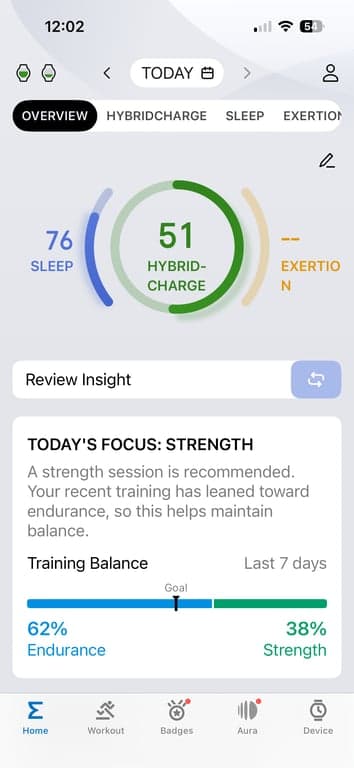
Amazfit has pushed a significant update to the Zepp app, the companion software behind every current Amazfit watch. The headline change: BioCharge and Readiness are gone, replaced by a single score called HybridCharge. That is a meaningful shift in how the platform thinks about recovery, and it matters if you train daily.
HybridCharge: What Changed and How It Works
HybridCharge pulls together the optical PPG data your wrist sensor already collects (heart rate variability, resting heart rate, sleep quality) and mixes it with self-reported inputs you log each morning. Think subjective fatigue, mood, soreness. The old BioCharge was purely biometric. The old Readiness score leaned on similar hardware data. Merging them into one number with a subjective layer is closer to what Whoop does with its Journal feature, where daily inputs like alcohol or illness adjust your recovery score. Garmin's Body Battery still runs on pure sensor data with no manual input, so if you hate journaling, that remains the cleaner alternative.
The approach makes physiological sense. Wrist optical sensors measure blood volume changes via light (PPG), not electrical signals like a chest strap would. That means HRV readings at the wrist are noisier than a Polar H10 or a Garmin HRM-Pro would deliver. Adding subjective context is a reasonable way to compensate for that noise floor. Whether the algorithm weights the two inputs intelligently is something that will take weeks of real-world testing to confirm.
Training Focus and the Official HYROX Integration
The update also introduces a Training Focus feature. Early descriptions suggest it guides users toward specific training stimulus targets across a week, similar to Garmin's suggested workouts or Coros's training load breakdown by aerobic and anaerobic buckets. Exact methodology is not yet public, so it is hard to say whether this is a genuine periodization engine or a simpler rule-based nudge system. For athletes already using the [Amazfit Cheetah 2 Pro](/en/articles/amazfit-cheetah-2-pro-review-running-cycling-and-swimming-tested-2026-05-29) or the [Amazfit Cheetah 2 Ultra](/en/articles/amazfit-cheetah-2-ultra-gps-battery-and-trail-climb-feature-tested-2026-05-25), this is a software upgrade on hardware you already own, which is always welcome.
The officially licensed HYROX tools are the most concrete addition. HYROX is a structured fitness race format with eight stations and eight 1km runs, so having purpose-built tracking inside Zepp rather than shoehorning it into a generic interval workout is genuinely useful. We have seen similar moves from Garmin with its HYROX activity profile, but Amazfit now has the official license, which implies closer alignment with actual event data, race formats, and possibly benchmark comparisons. For Hyrox athletes looking at the Cheetah 2 range, this makes the platform more relevant than it was six months ago.
Real Athlete Use Cases
For a triathlete or runner using an Amazfit watch daily, the practical question is simple: does HybridCharge give better day-to-day guidance than what came before? The dual-input model should reduce the number of mornings where the watch says you are fully recovered when your legs clearly disagree. That mismatch is a known frustration with pure-sensor readiness scores across all platforms, Garmin included. Cyclists doing long rides will also benefit here since the [Cheetah 2 Ultra already showed strong battery life in real conditions](/en/articles/amazfit-cheetah-2-ultra-battery-test-55-hours-on-a-real-ride-2026-05-24), meaning the watch will actually be on your wrist long enough to accumulate meaningful recovery data overnight.
For CrossFitters and Hyrox athletes, the new HYROX profile is the obvious draw. Structured station tracking, run segments, and load data in one place beats manually splitting activities. The training focus layer could also help balance strength and cardio stimulus across the week, though that depends on how well the algorithm handles mixed-modal load, something even Whoop struggles with on strength days.
What is missing is transparency. Amazfit has not published the weighting formula behind HybridCharge, the data sources feeding Training Focus, or how the HYROX integration handles edge cases like missed stations or GPS drift during indoor runs. Polar and Garmin publish more methodology detail, which matters when you are making training decisions based on a score. The subjective input component is also only useful if you actually complete it every morning, and compliance tends to drop after a few weeks for most athletes.
Bottom line: this is a solid platform upgrade for existing Amazfit users, especially Hyrox athletes and those already on the Cheetah 2 range. HybridCharge is a smarter approach to recovery scoring than a pure biometric number, and the HYROX license gives the platform real credibility in that space. If you are cross-shopping, Garmin's ecosystem is deeper and the Body Battery algorithm is more transparent, but Amazfit continues to close the gap at a lower price point. Worth updating immediately if you own an Amazfit watch.
Mentioned watches
Head-to-head comparisons