Amazfit Cheetah 2 Ultra: GPS, Battery, and Trail Climb Feature Tested
The Amazfit Cheetah 2 Ultra is making a real case for itself in 2026. A 55-hour battery projection from a 100km Isle of Wight ride, a trail climb feature that takes on Garmin's ClimbPro, and multi-discipline testing that puts it alongside the Garmin Forerunner 970, Whoop MG, and Polar Verity Sense , this is not the Amazfit of three years ago.
Battery and GPS: The Hard Numbers
The IoW ride is a serious test. Warm, sunny conditions, 100km of cycling, and the Cheetah 2 Ultra projected 55 hours of battery life based on drain recorded during the session. That puts it ahead of the Garmin Forerunner 970 in GPS-active mode, which typically delivers around 30 to 40 hours depending on settings. The Fenix 8 Solar can stretch further with solar input, but in standard GPS mode the Cheetah 2 Ultra's numbers are hard to argue with, as the5kRunner put it. GPS accuracy across the ride held up against the Wahoo Roam 3 as a reference point , a bike computer with a dedicated GPS antenna and no wrist-movement interference. Matching that standard on the wrist is not trivial.
Heart rate during the IoW ride was tracked optically on the wrist using a PPG sensor, which reads blood volume changes through light rather than electrical impulses. The Polar Verity Sense was used as a reference , an optical armband that also uses PPG, but benefits from a more stable placement on the forearm with less motion artifact than a wrist sensor during cycling. How closely the Cheetah 2 Ultra tracked the Verity Sense across varied intensities on the ride is the real question, and the5kRunner's session data addresses it directly.
Elevation Overview vs Garmin ClimbPro on Trail
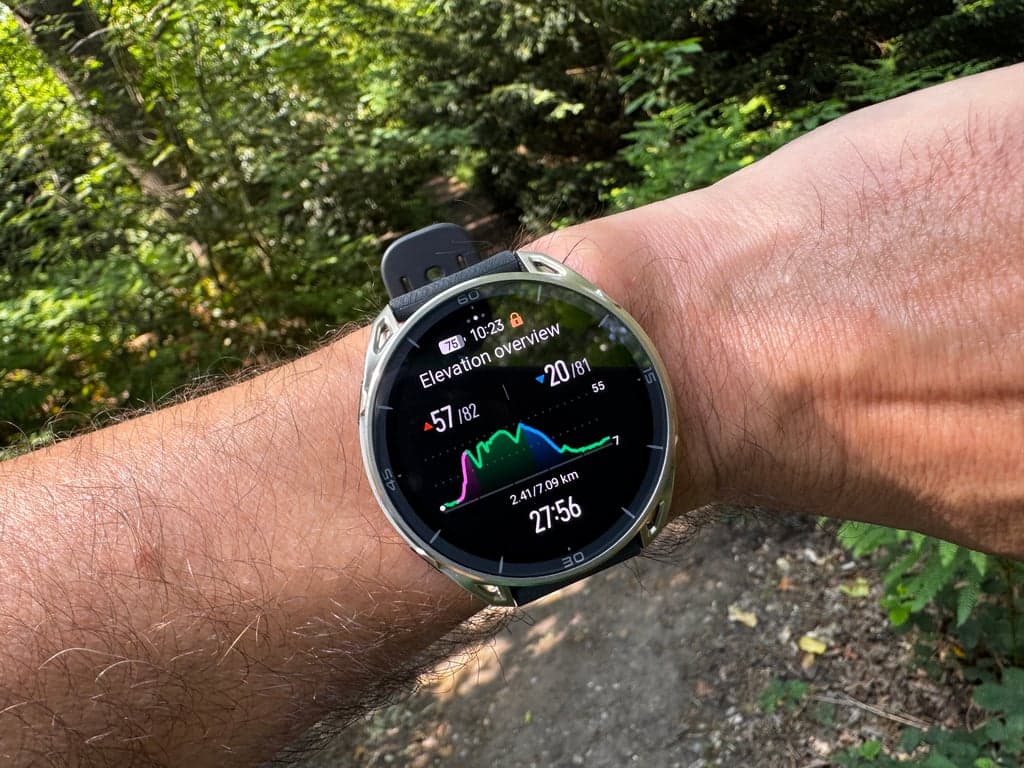
The trail run test at Wimbledon Common is where the Cheetah 2 Ultra's Elevation Overview feature gets its toughest look. Garmin's ClimbPro has been refined across multiple Fenix and Forerunner generations , it segments climbs automatically, gives you gradient, distance remaining, and time to summit, and adjusts in real time as your pace changes. Elevation Overview is colour-coded and functional. It works. But the metrics are fixed, meaning you can't customize what's displayed mid-climb, and the experience lacks the responsiveness that ClimbPro users will be used to on a Fenix 8 or Forerunner 970. For a trail runner who plans efforts by climb segment, that gap matters. For someone coming from a basic watch with no climb feature at all, Elevation Overview is a genuine step forward.
The barometric altimeter , which uses air pressure to calculate elevation rather than GPS satellite data , is the hardware behind both features. Accuracy here depends on calibration and atmospheric conditions. Garmin's implementation benefits from years of firmware tuning. Amazfit is working with the same sensor physics but a less mature software layer on top. The Wimbledon Common test gives a real-world view of how that plays out on actual trail terrain rather than a controlled climb on a treadmill.
How It Compares Across Disciplines
For triathletes and multi-sport athletes, the Cheetah 2 Ultra sits in a crowded bracket. Coros Pace 4 and Vertix 3 are eating into the performance segment with strong GPS and long battery. Apple Watch Ultra 3 owns the crossover crowd with ecosystem depth. Whoop MG, present in the IoW test, doesn't do GPS at all , it's a recovery and strain tool, not a race watch. The Cheetah 2 Ultra is trying to cover all the bases: GPS accuracy, battery life, heart rate tracking during training, and recovery metrics post-session. That's the same pitch Garmin makes with the Forerunner 970, at a price point that Garmin doesn't feel pressure to discount. If Amazfit's pricing stays meaningfully below Garmin's, the value case is strong. If the gap closes, the ecosystem argument swings back toward Garmin fast. You can see how the Cheetah 2 Ultra performed on the IoW ride in detail in our [Amazfit Cheetah 2 Ultra Battery Test: 55 Hours on a Real Ride](/en/articles/amazfit-cheetah-2-ultra-battery-test-55-hours-on-a-real-ride-2026-05-24), and the broader context on the watch sits in our [June 2026 Roundup](/en/articles/oura-ipo-garmin-eu-features-amazfit-cheetah-2-pro-june-2026-roundup-2026-05-22).
Recovery metrics are where Amazfit has historically lost ground to Garmin and Polar. HRV-based recovery scores depend on clean optical PPG data overnight, accurate signal processing, and a well-validated algorithm behind the scenes. Garmin's Body Battery and Polar's Nightly Recharge both have years of user data behind them. Whoop's strain and recovery model is built on a dedicated sensor worn 24/7. Amazfit's recovery tools on the Cheetah 2 Ultra are improved, but whether they're in the same league as those benchmarks still needs longer-term testing beyond a single ride or trail session.
What's missing or disappointing is predictable given the source. ClimbPro is more mature than Elevation Overview, full stop. Fixed metrics on a climb feature in 2026 feel like a version-one release that should have shipped with customization already built in. HR accuracy during high-intensity trail running , where wrist motion is significant and optical PPG sensors struggle , hasn't been fully addressed in the available test data yet. And Amazfit's software ecosystem, including third-party app support and training plan integration, still doesn't match what Garmin Connect or Coros's platform offer to serious athletes.
The Amazfit Cheetah 2 Ultra is the right watch for an endurance athlete who wants Garmin-level battery life without paying Garmin prices, and who does most of their training on road or gravel rather than technical trail. If trail running is your primary discipline, ClimbPro on a Forerunner 970 or Fenix 8 is still the better-tuned tool. If you're a cyclist or triathlete who needs 50-plus hours of GPS and honest heart rate data, the Cheetah 2 Ultra earns a serious look. For full running test data including Garmin and Polar comparisons, the [Amazfit Cheetah 2 Pro Review](/en/articles/amazfit-cheetah-2-pro-review-running-tests-vs-garmin-and-polar-2026-05-21) on TrackerBrief covers that ground in detail.
Mentioned watches
Head-to-head comparisons
Buying guides